
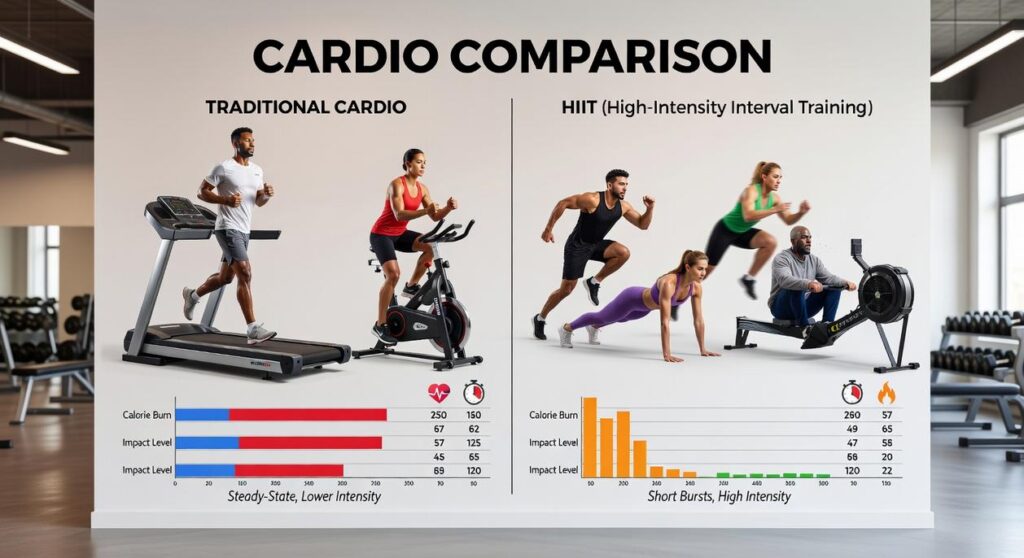
Head-to-Head Comparison: Which Cardio Wins for Your Goal?
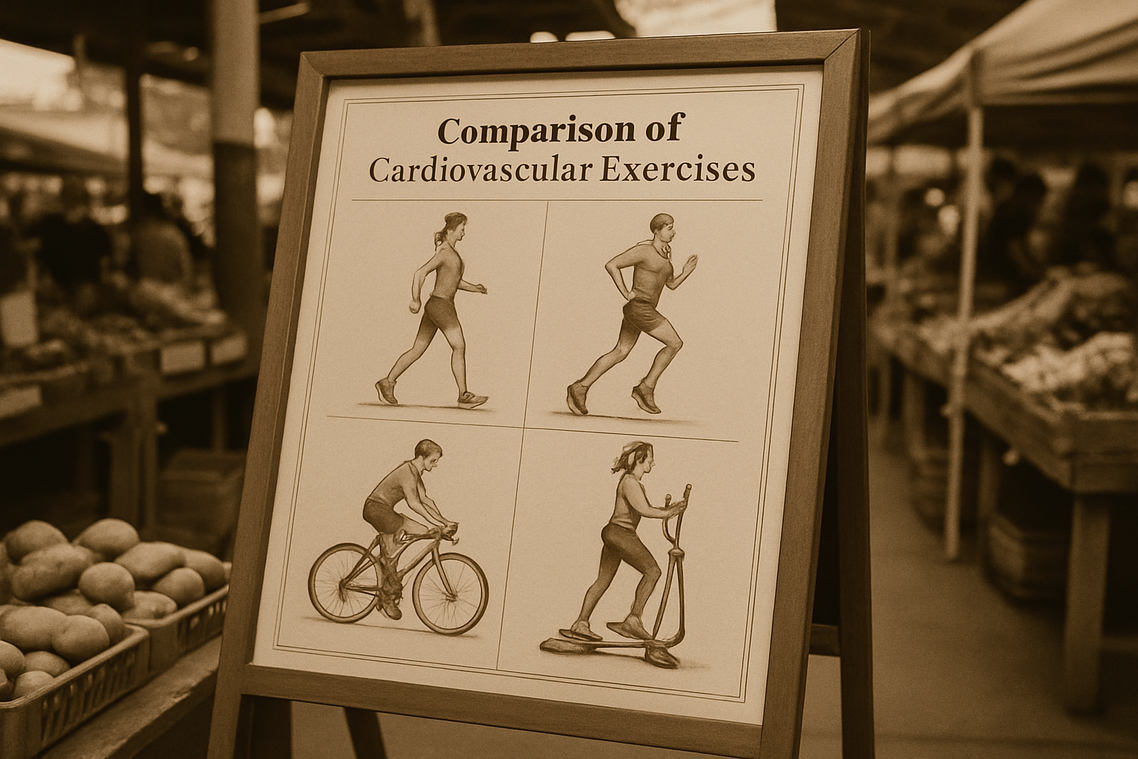
When people debate hiit vs steady state cardio, they’re usually asking a deeper question: What works best for me right now? The answer depends on your goal—and your timeline.
For Maximum Fat Loss
High-Intensity Interval Training (HIIT) leverages something called EPOC (excess post-exercise oxygen consumption), often referred to as the “afterburn effect.” This means your body continues burning calories after the workout ends as it restores oxygen levels and repairs muscle tissue.
Steady-state cardio, on the other hand, relies on duration. You burn calories while you’re moving—but once you stop, so does most of the elevated burn.
Research published in the Journal of Obesity (2011) found that HIIT can significantly reduce subcutaneous fat in less time compared to moderate steady-state exercise. So if your goal is maximum fat loss in a tight schedule, HIIT often pulls ahead. (Think 20 minutes of sprints versus an hour on the treadmill.)
Pro tip: Pair HIIT with strength training for even greater metabolic impact.
For Improving Heart Health
HIIT shines when it comes to improving VO2 max—a key marker of cardiovascular fitness that measures how efficiently your body uses oxygen during exercise. A 2014 meta-analysis in the British Journal of Sports Medicine found HIIT more effective than moderate-intensity continuous training for boosting VO2 max.
That said, steady-state cardio strengthens the heart muscle itself, improving stroke volume (how much blood your heart pumps per beat). Over several months, this can enhance endurance and lower resting heart rate.
If you’re training for a 10K or just want to feel less winded climbing stairs, steady-state builds a durable aerobic base.
For Time Efficiency
Clear winner: HIIT.
A 20-minute HIIT session can produce similar—or superior—cardiovascular and metabolic benefits compared to 45–60 minutes of steady-state cardio. Back in 2019, when time-crunched workouts surged in popularity, HIIT programs became the go-to for busy professionals (and parents squeezing workouts between school pickups).
If your calendar is chaos, HIIT respects your time.
For Beginners & Sustainability
Steady-state cardio has a lower barrier to entry. It’s less technically demanding, easier on joints, and places less stress on the nervous system.
For someone just starting out—or coming back after months off—brisk walking or light cycling is far more sustainable than all-out intervals. Recovery days? Steady-state wins again.
For Muscle Preservation
Long-duration cardio can become catabolic (muscle-breaking) if overdone. HIIT’s short, intense bursts are more muscle-sparing—and may even support anabolic (muscle-building) signals when programmed correctly.
So which wins? The one aligned with your goal—and your season of life.
The Best Cardio is the One You’ll Do
You came here looking for clarity on hiit vs steady state cardio—and now you have it.
You understand the distinct benefits of each. HIIT delivers intensity, efficiency, and a powerful metabolic boost. Steady-state cardio builds endurance, supports recovery, and offers a sustainable rhythm you can maintain long term.
The real struggle was never about which one is universally “better.” It was about which one fits your goals, your schedule, and your current fitness level. Choosing the wrong approach can leave you burned out, bored, or stuck without results.
When you align your cardio with your lifestyle and primary objective, you remove friction. And when fitness feels manageable, it becomes consistent. That’s where real progress happens.
So stop debating and start moving. Use this guide to design your ideal weekly routine today.
Consistency beats comparison—every time.

 Elviana Vosswyn writes the kind of nutrition and recovery approaches content that people actually send to each other. Not because it's flashy or controversial, but because it's the sort of thing where you read it and immediately think of three people who need to see it. Elviana has a talent for identifying the questions that a lot of people have but haven't quite figured out how to articulate yet — and then answering them properly.
They covers a lot of ground: Nutrition and Recovery Approaches, Metabolic Conditioning Insights, Wellness Spotlight Stories, and plenty of adjacent territory that doesn't always get treated with the same seriousness. The consistency across all of it is a certain kind of respect for the reader. Elviana doesn't assume people are stupid, and they doesn't assume they know everything either. They writes for someone who is genuinely trying to figure something out — because that's usually who's actually reading. That assumption shapes everything from how they structures an explanation to how much background they includes before getting to the point.
Beyond the practical stuff, there's something in Elviana's writing that reflects a real investment in the subject — not performed enthusiasm, but the kind of sustained interest that produces insight over time. They has been paying attention to nutrition and recovery approaches long enough that they notices things a more casual observer would miss. That depth shows up in the work in ways that are hard to fake.
Elviana Vosswyn writes the kind of nutrition and recovery approaches content that people actually send to each other. Not because it's flashy or controversial, but because it's the sort of thing where you read it and immediately think of three people who need to see it. Elviana has a talent for identifying the questions that a lot of people have but haven't quite figured out how to articulate yet — and then answering them properly.
They covers a lot of ground: Nutrition and Recovery Approaches, Metabolic Conditioning Insights, Wellness Spotlight Stories, and plenty of adjacent territory that doesn't always get treated with the same seriousness. The consistency across all of it is a certain kind of respect for the reader. Elviana doesn't assume people are stupid, and they doesn't assume they know everything either. They writes for someone who is genuinely trying to figure something out — because that's usually who's actually reading. That assumption shapes everything from how they structures an explanation to how much background they includes before getting to the point.
Beyond the practical stuff, there's something in Elviana's writing that reflects a real investment in the subject — not performed enthusiasm, but the kind of sustained interest that produces insight over time. They has been paying attention to nutrition and recovery approaches long enough that they notices things a more casual observer would miss. That depth shows up in the work in ways that are hard to fake.