

If your strength gains have stalled and your muscle growth has slowed to a crawl, you’re not alone. Hitting a plateau is one of the most frustrating parts of training—but it’s also a clear signal that your body needs a smarter stimulus. This guide delivers a complete, actionable blueprint built around the science of progressive overload training—the proven key to continuous muscle growth. Instead of random workouts and guesswork, you’ll get a structured, repeatable framework designed to push past plateaus and drive consistent results. Backed by real-world application in strength and metabolic conditioning, this is your clear, no-fluff path to getting stronger and building lasting muscle.
What is Progressive Overload? The Science of Getting Stronger
Progressive overload is the simple idea of gradually increasing the stress placed on your muscles and nervous system over time. In plain English: if you want to get stronger, you have to ask your body to do a little more than it’s used to.
Your body is an adaptation machine. When you lift weights, you create a stimulus—a demand for change. If that demand stays the same, your results stall (your body loves efficiency). To build strength and muscle—also called hypertrophy, or muscle growth—you must consistently increase that challenge.
Many people think progressive overload training only means lifting heavier weights. Not true. You can:
- Add reps
- Slow your tempo
- Increase sets
- Reduce rest time
Think of it like learning math. You don’t jump into calculus before mastering arithmetic. Pro tip: Track one variable each week and increase it slightly. Small, steady upgrades win long term.
The 5 Methods of Applying Progressive Overload
Let’s be honest. Few things are more frustrating than showing up to the gym, putting in the work, and seeing… nothing change. Same weights. Same reps. Same results. If you feel stuck, it’s usually not a motivation problem—it’s a progression problem.
Here are five practical ways to apply progressive overload training so your body actually gets the memo.
1. Increase Resistance (Intensity)
This is the classic move: add more weight. A good rule of thumb is 2.5–5 lbs for upper body lifts and 5–10 lbs for lower body lifts. Small jumps add up fast (your ego may want more, but your joints will thank you for patience).
2. Increase Repetitions (Reps)
Keep the same weight and push for more reps. If you benched 100 lbs for 8 reps last week, aim for 9 or 10 this week. More reps increase time under tension—a key driver of muscle growth (Schoenfeld, 2010).
3. Increase Volume (Sets)
Add a set. Three sets of 10 become four sets of 10. That extra workload increases total training volume, which research links to hypertrophy gains (Krieger, 2010).
4. Decrease Rest Time
Shorten rest between sets to boost workout density. Less rest increases metabolic stress, another muscle-building stimulus. Hate feeling out of breath? That’s kind of the point.
5. Improve Technique/Range of Motion
A deeper squat. A slower, controlled negative. Cleaner form. Better reps create more effective tension—arguably the most overlooked progression of all.
Still doing the exact same workout from three months ago and expecting different results?
A Sample 4-Week Progressive Overload Training Program
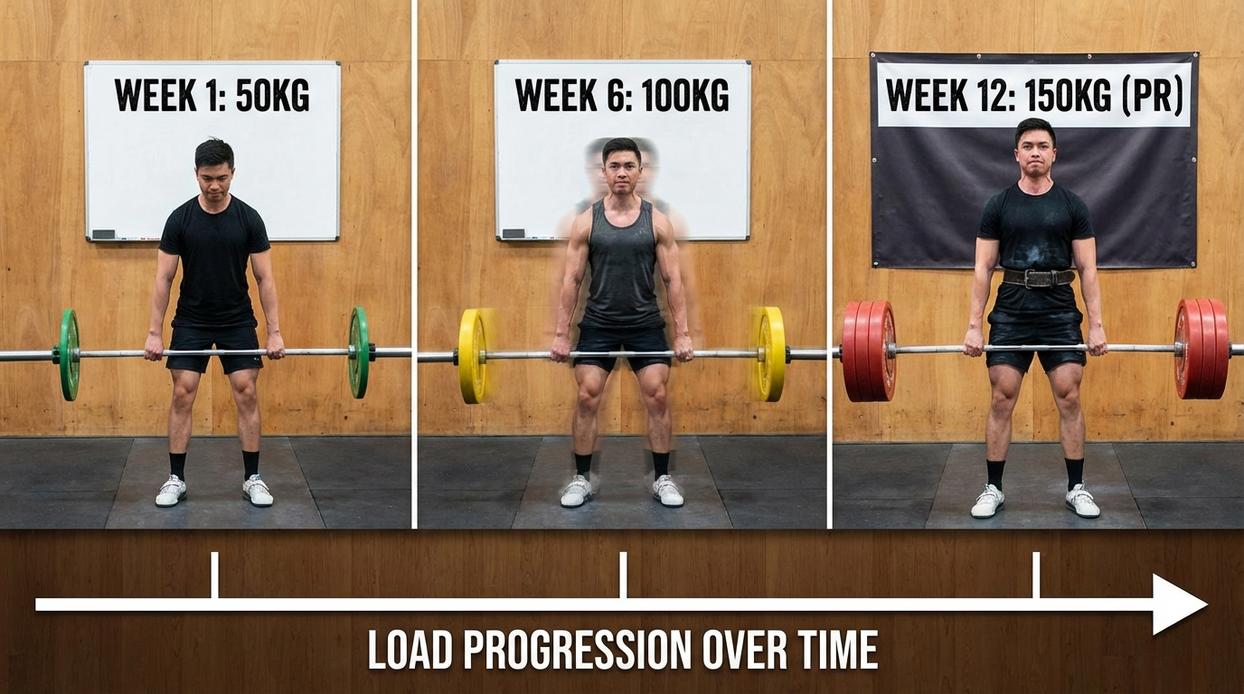
If you want real strength and muscle gains, you need a plan—not random workouts. The key principle here is progressive overload training, which simply means gradually increasing the demand placed on your muscles over time. (Your body adapts fast—don’t give it a reason to stay comfortable.)
Below is a practical 4-day upper/lower split you can follow immediately.
Day 1: Upper Body
- Bench Press (3×8–10)
- Barbell Row (3×8–10)
- Overhead Press (3×10–12)
- Lat Pulldown (3×10–12)
- Bicep Curls (2×12–15)
Day 2: Lower Body
- Back Squat (3×8–10)
- Romanian Deadlift (3×8–10)
- Walking Lunges (3×10 each leg)
- Leg Curl (3×10–12)
- Calf Raises (3×12–15)
Repeat with slight variations for Days 3 and 4.
The Double Progression Model (Step-by-Step)
-
Week 1 – Establish Baseline
Choose a weight you can lift for 3 sets of 8 reps, but not 11. Leave 1–2 reps “in the tank” (this is called Reps in Reserve, meaning how many reps you could still perform before failure). -
Week 2 – Add Reps
Keep the same weight. Aim for 9–10 reps per set. -
Week 3 – Hit the Ceiling
Once you achieve 3×10 (top of range), you’ve earned progression. -
Week 4 – Increase Load
Add the smallest weight increment possible and return to 3×8.
Pro tip: Small jumps (2.5–5 lbs) compound dramatically over months.
Most people think they’re progressing—but they’re guessing. That’s why a workout log or tracking app is non-negotiable. Record weight, reps, and sets every session. If the numbers aren’t improving, neither are you.
If you’re debating formats, see circuit training vs traditional workouts which method delivers better results.
Consistency beats motivation. Track it. Progress it. Repeat.
Muscle isn’t built in the gym alone; the workout is the spark. Repair and growth happen after the last rep. During progressive overload training, fibers experience microtears that require raw materials and downtime to rebuild stronger.
- Protein for Repair: Aim for 0.8–1 gram per pound of body weight daily to stimulate muscle protein synthesis and limit breakdown.
- Energy for Performance: Carbohydrates replenish glycogen, the fuel that powers sessions and keeps output high.
- Sleep as a Non-Negotiable: Seven to nine hours of sleep supports growth hormone release, tissue repair, and nervous system recovery.
Skip them and progress stalls—why?
Build Your Stronger Self, Starting Today
You came here looking for a clear, sustainable way to get stronger without spinning your wheels. Now you have a structured approach that removes confusion and replaces it with purpose. No more random workouts. No more stalled progress.
By committing to progressive overload training, you force real, measurable change. That’s how strength is built—intentionally, consistently, and patiently.
The only thing standing between you and results is action. Start today. Track your first workout. Follow the plan for one full week.
Your stronger, more confident self is built one recorded rep at a time. Open your notebook and begin now.
