If you’re searching for a clear, practical guide to functional training fundamentals, you likely want more than trendy workouts or complicated routines. You want to understand how to move better, build real-world strength, and improve endurance in a way that supports your daily life. This article is designed to do exactly that.
We break down the core principles behind functional movement, explain how metabolic conditioning fits into a balanced routine, and outline simple strategies you can apply whether you’re training at home or in the gym. Instead of vague advice, you’ll find actionable guidance rooted in established exercise science and informed by leading strength and conditioning research.
By the end, you’ll know how to structure workouts that enhance mobility, stability, power, and recovery—so your training translates into better performance, reduced injury risk, and sustainable progress over time.
Carrying groceries, lifting a suitcase, or chasing your kids shouldn’t feel like a max-effort workout. Yet many gym routines centered on bicep curls and machine presses build mirror muscles, not real-world strength. The result? Imbalances, stiff joints, and higher injury risk, according to the American Council on Exercise.
This guide breaks down functional training fundamentals that improve:
- Mobility
- Stability
- Coordinated strength
You’ll learn specific movement patterns—squats, hinges, pushes, pulls, and carries—and why they translate directly to daily life. Because training should make life easier (not just your selfies stronger). Stronger movement builds resilient, capable bodies for longevity.
Principle 1: Integrate, Don’t Isolate
Functional training prioritizes multi-joint, compound movements that require multiple muscle groups to work together in coordination. Instead of training muscles like solo artists, you train them like a band—tight, synchronized, and powerful.
Take a leg extension. It isolates your quadriceps while you sit down. Useful? Sure. But life rarely happens seated. Now compare that to a goblet squat. Your quads, glutes, core, and back all fire together. That’s how you stand up, lift boxes, or pick up a toddler mid-tantrum (real-world strength at its finest).
This approach reflects true functional training fundamentals: train movements, not just muscles.
Actionable examples:
- Push-ups: Mimic pushing a heavy door or getting up off the floor.
- Rows: Replicate pulling a lawnmower cord or dragging something toward you.
- Farmer’s walks: Simulate carrying groceries, luggage, or two overstuffed backpacks like you’re in an action movie montage.
What’s in it for you?
- Improved muscular coordination (your body moves as one unit).
- Greater metabolic demand, meaning higher calorie burn (more work in less time).
- Enhanced efficiency—fewer exercises, better results.
Some argue isolation builds better muscle detail. Fair point. But if your goal is strength that transfers to real life, integration wins—every time.
Principle 2: Master the Primal Movement Patterns
Every complex lift, sport skill, or everyday task traces back to a handful of foundational patterns. Think of them as the movement equivalent of primary colors—blend them well, and you can create almost anything (yes, even that superhero landing you attempt after burpees).
These patterns form the backbone of functional training fundamentals and ensure your body develops strength in a balanced way.
- Push (Horizontal & Vertical): Moving weight away from your body. Examples: Dumbbell Bench Press, Overhead Press. Essential for building chest, shoulders, and triceps strength.
- Pull (Horizontal & Vertical): Bringing weight toward your body. Examples: Bent-Over Row, Pull-Up. Critical for posture and upper-back resilience.
- Squat: Coordinated bending of hips, knees, and ankles. Example: Bodyweight Squat. Mimics sitting and standing—something you’ll want to keep doing for decades.
- Hinge: Bending at the hips with a neutral spine. Examples: Kettlebell Swing, Romanian Deadlift. Powers jumping and protects your lower back.
- Lunge: Step-and-return single-leg movement. Example: Walking Lunge. Trains balance and real-world coordination.
- Carry: Transporting load over distance. Example: Farmer’s Walk. Builds grip, core stability, and mental grit.
- Rotate: Twisting from the core. Example: Cable Wood Chop. Enhances athletic power and spinal control.
The primary benefit? Training these patterns creates a well-rounded physique that’s less prone to injury (because weak links don’t get a chance to hide).
Some argue isolation machines are safer or more efficient. Fair point. But neglecting movement patterns may limit long-term resilience. Speculation: As wearable tech advances, programs built around these primal patterns will likely dominate mainstream fitness for their measurable, transferable results.
Principle 3: Train Across All Three Planes of Motion

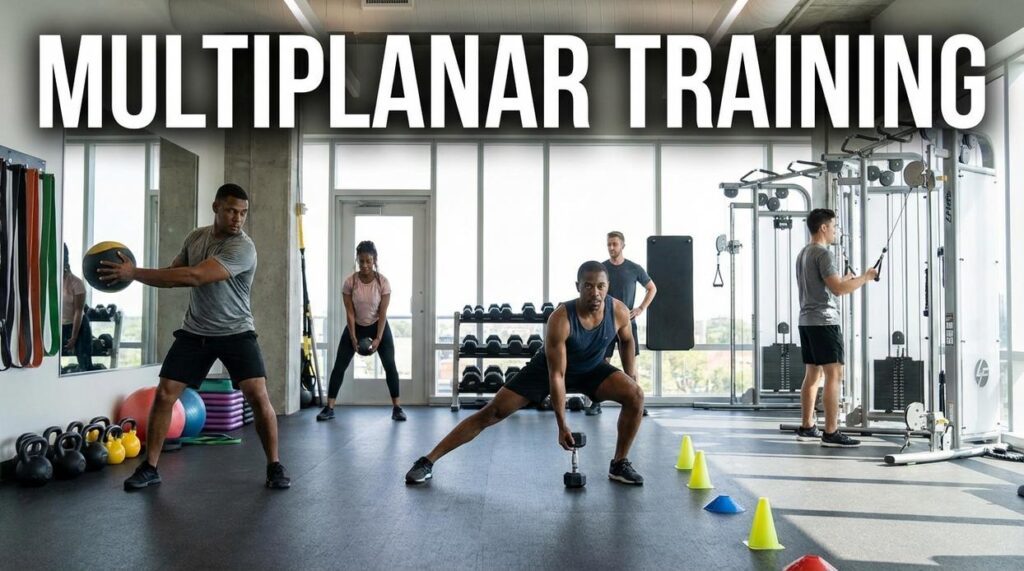
Your body moves in three planes. Sagittal means forward and backward (think squats or running). Frontal is side-to-side movement (like side lunges). Transverse involves rotation (medicine ball throws or Russian twists). Simple in theory—yet most gym programs live almost entirely in the sagittal plane.
That’s the problem.
Yes, barbells and treadmills build strength and endurance. However, real life rarely happens in straight lines. You twist to grab groceries, sidestep a puddle, or pivot during a pickup game. Ignoring frontal and transverse work limits agility and joint stability.
Add lateral raises or Cossack squats for frontal strength. Incorporate rotational chops or throws for transverse power. These aren’t “extras”—they’re functional training fundamentals that improve reaction time and reduce injury risk (ACSM, 2022).
Some argue isolation lifts are enough. But athletes—and anyone who wants resilient knees and hips—benefit from multi-planar balance.
For long-term structure, see periodization in fitness how to structure your training year.
Train in 3D. Your body already does.
Principle 4: Build Strength from the Core Out
When most people hear core, they picture six-pack abs. But the core is actually a 360-degree muscular system wrapping around your torso—abdominals, obliques, lower back, diaphragm, and glutes. Think of it less like a showpiece and more like a weight belt built into your body (and thankfully, it doesn’t clash with your gym outfit).
Research shows that core stability training improves balance and reduces injury risk, particularly lower back pain, which affects up to 80% of adults at some point in their lives (National Institutes of Health). That’s because the core’s primary job isn’t to bend your spine—it’s to stabilize it and transfer force between your upper and lower body. When that system is weak, energy “leaks” during movement, limiting strength and increasing strain.
This is where functional training fundamentals matter. Instead of endless sit-ups, focus on resisting motion:
- Planks (anti-extension), Pallof presses (anti-rotation), and Bird-Dogs (anti-flexion).
These exercises train your body to prevent unwanted movement, which mirrors real life and sport. Studies in the Journal of Strength and Conditioning Research show that anti-rotation and stabilization drills improve force production in compound lifts.
The payoff? Better posture, fewer aches, and more power in every lift, sprint, or grocery carry you perform.
Functional fitness is more than workouts; it’s a philosophy of preparing your body for life’s real demands. Research shows multi‑joint, integrated movements improve balance and reduce injury risk by up to 30% in active adults (NSCA). Instead of disjointed exercises, you now have a holistic system built on functional training fundamentals—patterns that mirror how you lift, twist, and carry daily (yes, even hauling groceries).
By focusing on:
- Primal movement patterns
- Multi‑planar training
- A resilient core
you create strength that transfers beyond the gym.
Your next step: add one rotational or lateral move to your very next workout—and feel the difference immediately.
Build Strength That Actually Supports Your Life
You came here to better understand how to train in a way that improves real-life strength, mobility, and endurance — not just how you look in the mirror. Now you know that focusing on functional training fundamentals helps you move better, reduce injury risk, and build strength that carries over into everyday life.
The real pain point isn’t lack of effort. It’s wasting time on workouts that don’t translate into practical results. Random exercises and isolated movements won’t give you the resilient, capable body you’re after.
The solution is simple: train with intention. Prioritize movement patterns, core stability, balance, and progressive overload. Stay consistent. Track your performance. Recover with purpose.
If you’re ready to stop spinning your wheels and start seeing real-world results, it’s time to follow a structured plan built around functional training fundamentals. Join thousands of readers who rely on our proven strategies for smarter workouts, faster recovery, and sustainable strength. Start today and take control of your performance before another week of ineffective training slips by.

 Bruce R. is the kind of writer who genuinely cannot publish something without checking it twice. Maybe three times. They came to nutrition and recovery approaches through years of hands-on work rather than theory, which means the things they writes about — Nutrition and Recovery Approaches, Pro Perspectives, Metabolic Conditioning Insights, among other areas — are things they has actually tested, questioned, and revised opinions on more than once.
That shows in the work. Bruce's pieces tend to go a level deeper than most. Not in a way that becomes unreadable, but in a way that makes you realize you'd been missing something important. They has a habit of finding the detail that everybody else glosses over and making it the center of the story — which sounds simple, but takes a rare combination of curiosity and patience to pull off consistently. The writing never feels rushed. It feels like someone who sat with the subject long enough to actually understand it.
Outside of specific topics, what Bruce cares about most is whether the reader walks away with something useful. Not impressed. Not entertained. Useful. That's a harder bar to clear than it sounds, and they clears it more often than not — which is why readers tend to remember Bruce's articles long after they've forgotten the headline.
Bruce R. is the kind of writer who genuinely cannot publish something without checking it twice. Maybe three times. They came to nutrition and recovery approaches through years of hands-on work rather than theory, which means the things they writes about — Nutrition and Recovery Approaches, Pro Perspectives, Metabolic Conditioning Insights, among other areas — are things they has actually tested, questioned, and revised opinions on more than once.
That shows in the work. Bruce's pieces tend to go a level deeper than most. Not in a way that becomes unreadable, but in a way that makes you realize you'd been missing something important. They has a habit of finding the detail that everybody else glosses over and making it the center of the story — which sounds simple, but takes a rare combination of curiosity and patience to pull off consistently. The writing never feels rushed. It feels like someone who sat with the subject long enough to actually understand it.
Outside of specific topics, what Bruce cares about most is whether the reader walks away with something useful. Not impressed. Not entertained. Useful. That's a harder bar to clear than it sounds, and they clears it more often than not — which is why readers tend to remember Bruce's articles long after they've forgotten the headline.